

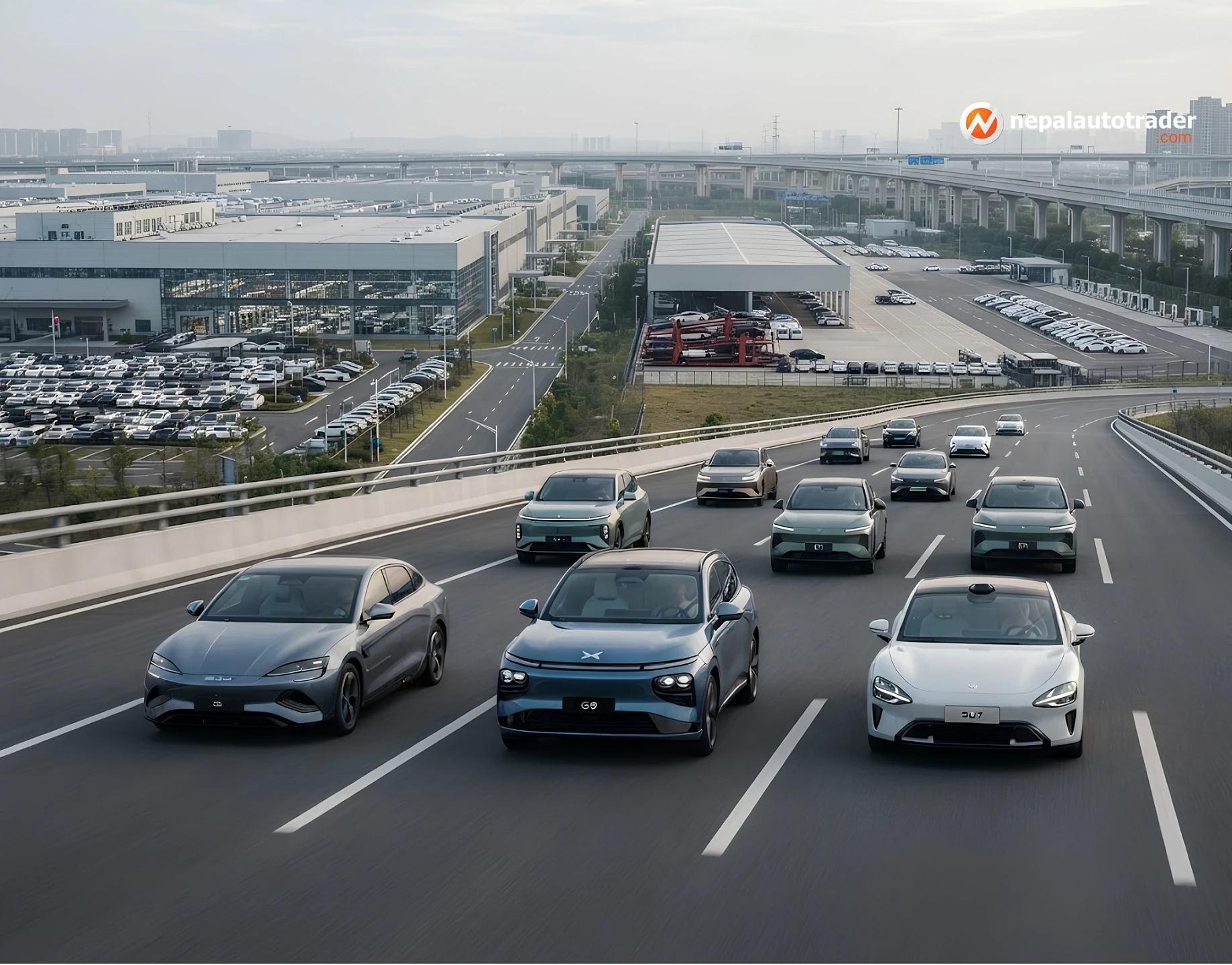
China's automotive competition is becoming harder to ignore. The October 2026 figures offer another look at the scale of the country's car industry, with established manufacturers and younger electric vehicle companies competing for increasingly large volumes.
BYD remains the biggest name in the latest figures, recording 483,125 passenger car sales globally during October. Geely followed with 214,996 units. But the more interesting development may be happening further down the rankings.
Leapmotor delivered more than 100,000 vehicles for the fourth month in a row, while XPeng crossed a monthly delivery milestone of its own. These are not small achievements in a market where several manufacturers are fighting for the same customers.
The numbers also show that the competitive landscape is broader than a simple BYD versus Geely contest.
BYD finished October at the top of the reported global passenger car sales ranking, with 483,125 units. Its lead over Geely was substantial, with the second-ranked manufacturer recording 214,996 units during the same month.
The strength of BYD's performance came largely from its two major passenger vehicle families, Dynasty and Ocean. Together, they contributed 423,843 units to the company's total.
The remaining contribution came from its other brands, including Fangchengbao, Denza and Yangwang. Their individual figures show how BYD has built a broad product portfolio rather than relying on one successful vehicle family.
| BYD brand or series | October 2026 sales |
|---|---|
| Dynasty and Ocean | 423,843 units |
| Fangchengbao | 43,872 units |
| Denza | 15,152 units |
| Yangwang | 258 units |
| BYD total | 483,125 units |
The figures reveal something important about the company's structure. Dynasty and Ocean alone accounted for the overwhelming majority of reported sales, while the other brands added further reach across different parts of the market.
Fangchengbao's 43,872 units are particularly notable within the wider portfolio. Denza contributed another 15,152, while Yangwang recorded 258 units.
BYD's position is not built around a single model or a single price category. Its wider brand structure gives it several ways to compete for customers.
Geely finished October in second position, selling 214,996 passenger cars. Its performance was supported by Geely Galaxy, which contributed 153,385 units.
The company's wider portfolio also includes Zeekr and Lynk & Co. These brands recorded 32,483 and 18,521 units respectively during October.
| Geely brand | October 2026 sales |
|---|---|
| Geely Galaxy | 153,385 units |
| Zeekr | 32,483 units |
| Lynk & Co | 18,521 units |
| Geely total | 214,996 units |
Geely Galaxy remains the largest contributor among the three reported divisions. Zeekr and Lynk & Co add further volume through their respective brand identities.
The gap between BYD and Geely is considerable in this monthly ranking. However, the figures also underline how important a multi-brand strategy has become among Chinese manufacturers.
For Geely, maintaining a strong position will depend on the performance of its wider portfolio, not simply the success of Galaxy.
One of October's most striking performances came from Leapmotor. The company delivered 106,127 vehicles during the month, marking a 50.99% increase compared with October last year.
There is another milestone behind that number. Leapmotor has now delivered more than 100,000 vehicles in each of the last four consecutive months.
That consistency matters. A single strong month can reflect temporary demand or a particularly successful launch. Maintaining six-figure monthly deliveries over consecutive months points to a much larger operating scale.
Leapmotor's performance is also relevant to international markets. The brand has an expanding presence outside China, supported by its international partnership with Stellantis. Its growing production and delivery volumes could strengthen its position as it develops that overseas business.
For Nepal, the brand is already more than a distant Chinese market name. Leapmotor vehicles are distributed locally through Shangrila Motors, including models such as the T03, B03X, B10 and C10.
The B03X, known as the A10 in China, is particularly relevant. Its growing popularity in its home market offers an interesting connection between Chinese sales performance and the models arriving in Nepal.
Strong domestic deliveries do not automatically translate into overseas success, of course. Export demand, local pricing, distribution and after-sales support will determine how much of that momentum can be carried into markets such as Nepal.
XPeng also reached an important milestone in October, delivering 50,237 vehicles. It was the company's first month with more than 50,000 deliveries.
The result represented 19.6% year-on-year growth and a 21.8% increase compared with September. Both figures point to a strong month for the manufacturer.
Other manufacturers and brands also reported substantial volumes.
These figures matter because the competition is no longer limited to companies traditionally identified as electric vehicle specialists. Established manufacturers are developing dedicated new energy vehicle brands, while technology companies are also entering the automotive business.
Xiaomi's reported monthly delivery volume is one example of how the competitive field continues to expand. The company has crossed the 50,000-unit threshold, although the exact October figure remains undisclosed in the source report.
Changan's Nevo brand also deserves attention. Its 63,648 units demonstrate the scale that a dedicated new energy vehicle portfolio can achieve.
October's figures provide a useful snapshot of the changing automotive industry. BYD continues to dominate the reported ranking, Geely maintains a strong second position, and Leapmotor and XPeng are building delivery volumes that would have been difficult to associate with younger EV manufacturers only a few years ago.
There are several developments worth watching:
For Nepal, the developments have a practical connection. Several Chinese brands represented in these figures already have vehicles in the local market. The success of their products in China can offer useful context when assessing their international ambitions, although it does not guarantee local sales performance.
One limitation should remain clear. These figures do not provide a complete breakdown of China's total new energy vehicle market, nor do they establish market share for each manufacturer. BYD and Geely are reported through passenger car sales, while Leapmotor and XPeng are reported through deliveries. Great Wall Motor's figure specifically covers new energy vehicles.
Those reporting differences matter when comparing manufacturers. The headline numbers are impressive, but they should not be treated as a perfectly uniform industry ranking.
The next few monthly reports will show whether Leapmotor can maintain its current pace, whether XPeng can build on its October milestone and whether BYD can preserve its enormous lead. China's automotive race is no longer just about who builds the most electric cars. It is increasingly about who can sustain volume across multiple brands and markets.
Q: Which car manufacturer sold the most vehicles in October 2026?
A: BYD ranked first in the reported global passenger car sales figures, recording 483,125 units. Geely followed with 214,996 units.
Q: How many vehicles did BYD sell in October 2026?
A: BYD recorded 483,125 passenger car sales. Its Dynasty and Ocean series contributed 423,843 units combined.
Q: How many vehicles did Leapmotor deliver in October 2026?
A: Leapmotor delivered 106,127 vehicles. This represented 50.99% year-on-year growth and marked its fourth consecutive month above 100,000 deliveries.
Q: How many vehicles did XPeng deliver in October?
A: XPeng delivered 50,237 vehicles in October 2026. It was the company's first month above 50,000 deliveries, representing 19.6% annual growth.
Q: Which other Chinese manufacturers reported strong October figures?
A: Changan's Nevo brand recorded 63,648 units, while Great Wall Motor reported 49,499 new energy vehicle sales. Xiaomi also delivered more than 50,000 vehicles, although its exact total was not disclosed.
Q: Are Leapmotor vehicles available in Nepal?
A: Yes. Leapmotor vehicles are distributed in Nepal through Shangrila Motors. Its local lineup includes the T03, B03X, B10 and C10.

Nepal Auto-Trader is one-stop platform for all automotive needs. We provide unbiased and unparalleled news/reviews of all auto-motives being launched in Nepalese Auto-Industry. Find recent updates and price of bikes/cars, compare and review recently launched bikes/cars, buy/sell/trade reconditioned cars/bikes and all government news about changing rules and regulation, road safety by subscribing us.

Subscribe to our Newsletter
© Copyright 2026, Nepal Autotrader


.png)
.png)